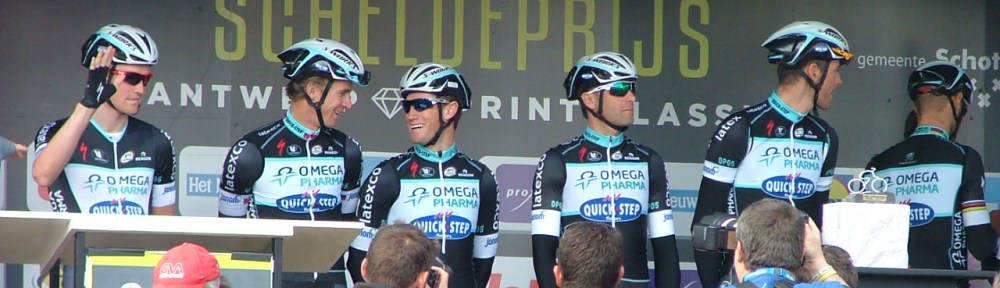
Schelde – who? Even for ardent cycling fans the mention of this race rarely quickens the pulse and many won’t even have heard of it.
Which is actually rather strange; the race dates back to 1907, making it the oldest race in cycling-mad Flanders. It features stretches of cobbles and former winners read like a who’s who of cycling royalty (Eddy Merckx, Rik Van Looy, Roger de Vlaeminck and Mario Cipollini to name a few). By all accounts you’d expect it to be considered a fully fledged Classic.
Occupying an anonymous mid-week slot between The Tour of Flanders and Paris-Roubaix and taking place over a largely flat course, it is inevitably overshadowed by its more famously gruelling neighbours. But this scheduling is exactly why it’s worth a visit: many of the star riders taking part in both Monuments will appear at Scheldeprijs to keep their legs turning over between these races, but the lower-key nature of the event means they are more relaxed and visible at the sign-on.

Fabian Cancellara swings by after winning the Tour of Flanders
The flat course suits sprinters and attracts big names in its own right – Marcel Kittel and Mark Cavendish have each won the race three times in recent years.
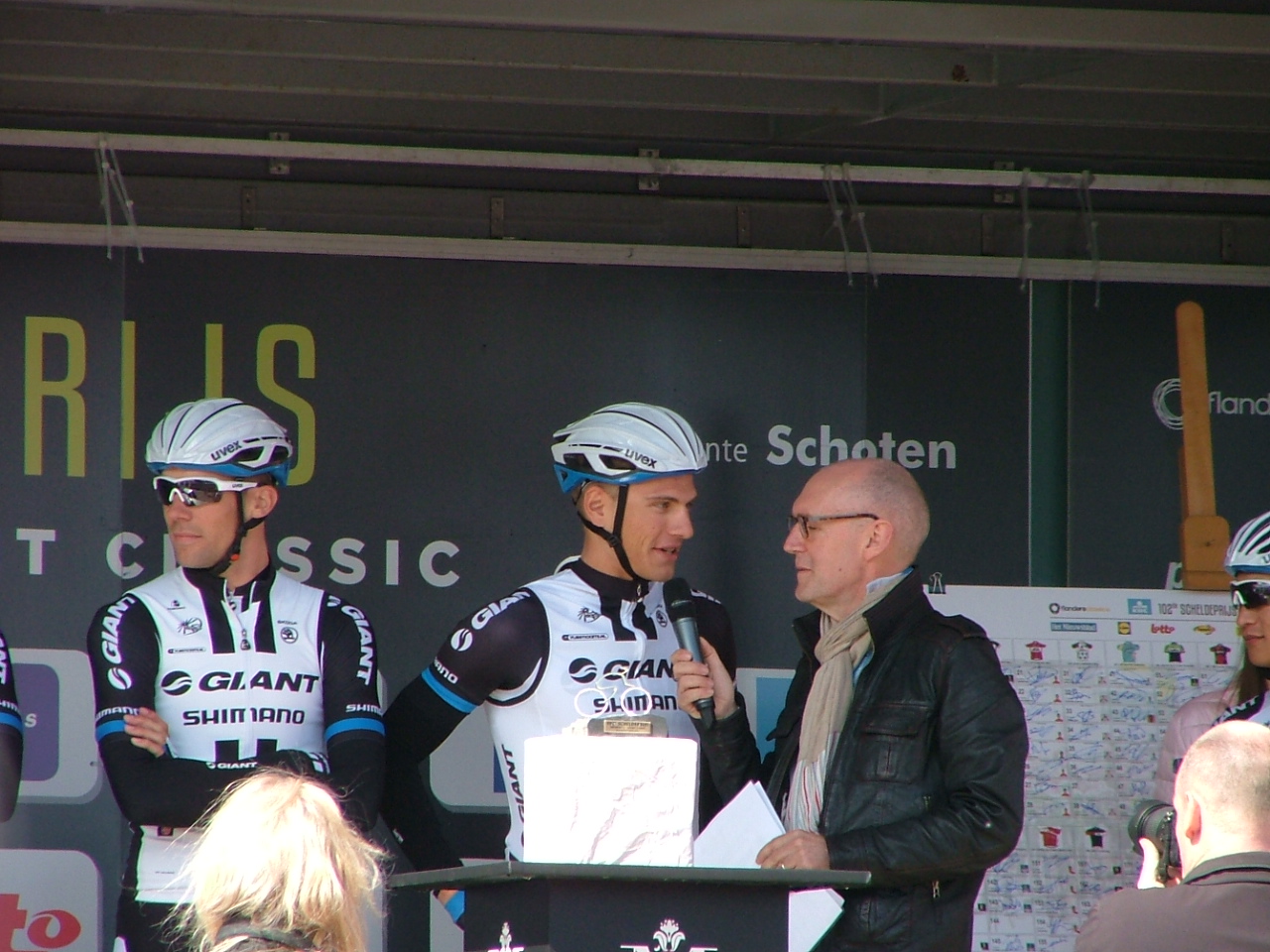
Marcel Kittel in front of the trophy he would go on to win for the third time
How to visit
Another reason to go and see the race is that it starts in Antwerp, Belgium’s second city and well worth a visit on any occasion. We went on a day trip from Ghent, catching a train from Gent-Dampoort station to the spectacular neo-Gothic Antwerp Centraal station, which takes about 50 minutes.

Remember where you park your bike at train stations in Ghent!
From the station head west towards the river Scheldt (or Schelde in Dutch, hence the name Scheldeprijs). This allows you to take in the sights of the old heart of Antwerp, that centres around the impressive Grote Markt and features everything you’ve come to expect from a medieval Flemish market town (impressive guild houses? Town hall? Church with belltower (which in this case is a magnificent cathedral)? Tick, tick, tick). The square also features the Brabo Fountain, which depicts the legend which allegedly gave Antwerp its name ( a plucky Roman warrior by the name of Silvius Brabo killed and cut off the hand of a greedy giant who forced passing ships to pay a toll, and threw it in the Scheldt. Hand werpen means “hand throwing”).

The Grote Markt and Brabo Fountain

Antwerp’s amazing cathedral
Once at the river you need to head north into a regenerated docklands area called ‘t Eilandje. The race starts outside MAS (Museum aan de Stroom), a museum of various exhibits relating to Antwerp, which is very easy to spot:
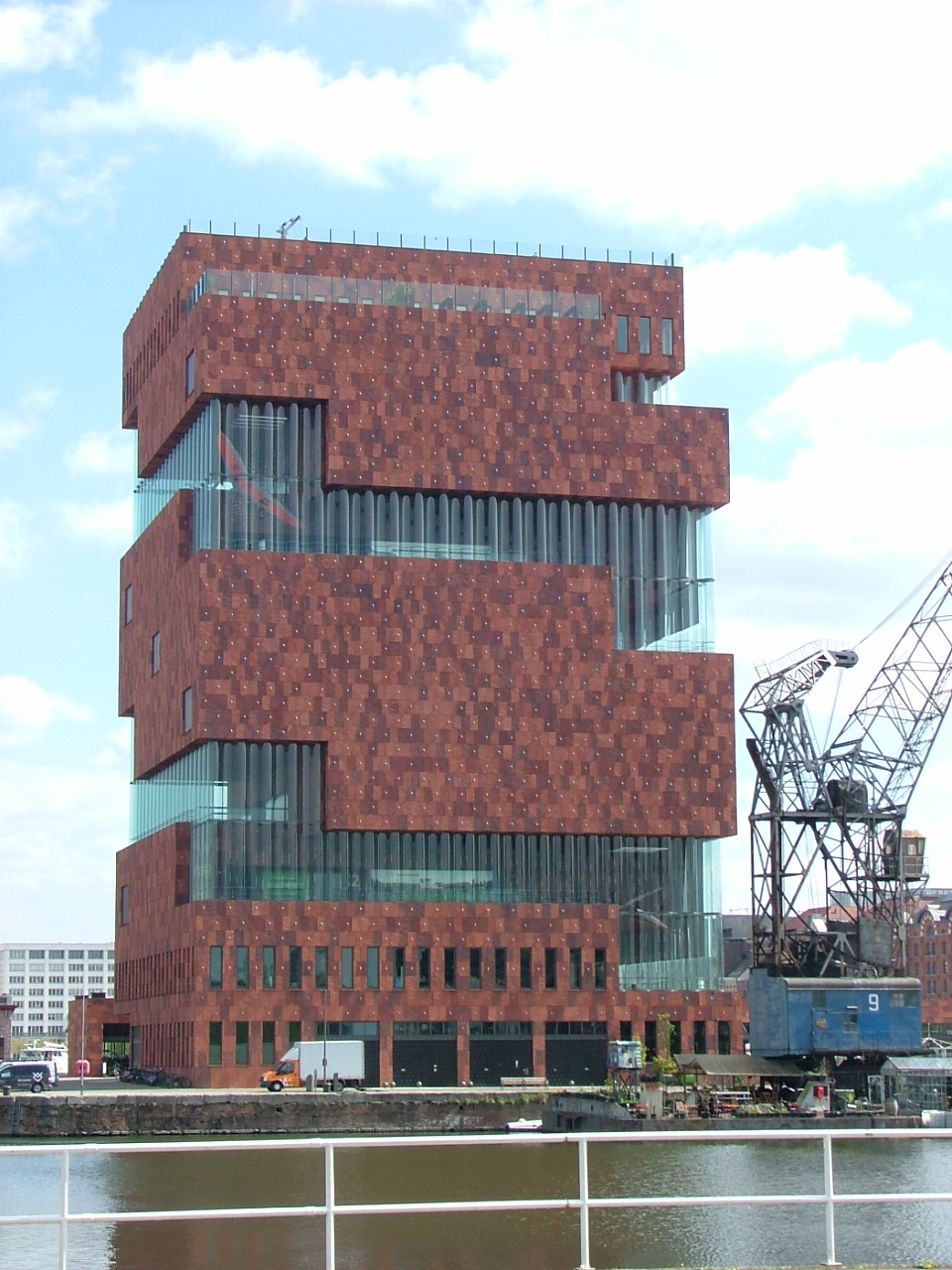
MAS
It’s in the square outside here that you can see all those aforementioned famous riders sign in before the race, getting far more up close and personal than is possible at the Tour of Flanders – many of the same riders but a tiny crowd of fans in comparison.
The lower-key feel of the race might explain why when we went to watch the race in 2014 Bradley Wiggins, who had been painfully curt when interviewed at the Tour of Flanders three days earlier, was on charming and hilarious form when interviewed by the same guy before this race. The more even tempered Tom Boonen patiently gave autographs to starstruck kids who wandered onto the stage without being challenged by security.
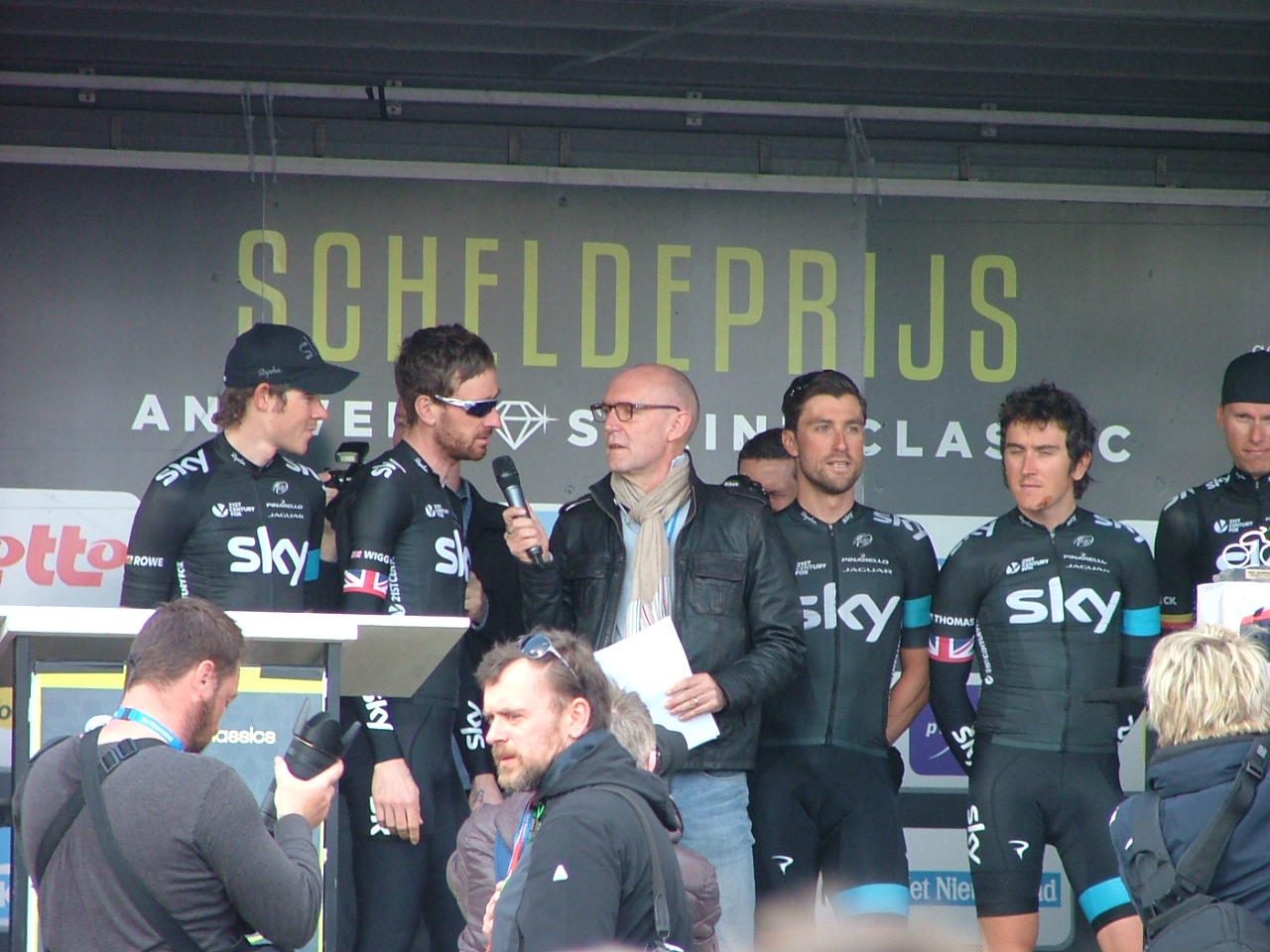
Wiggo turns on the charm
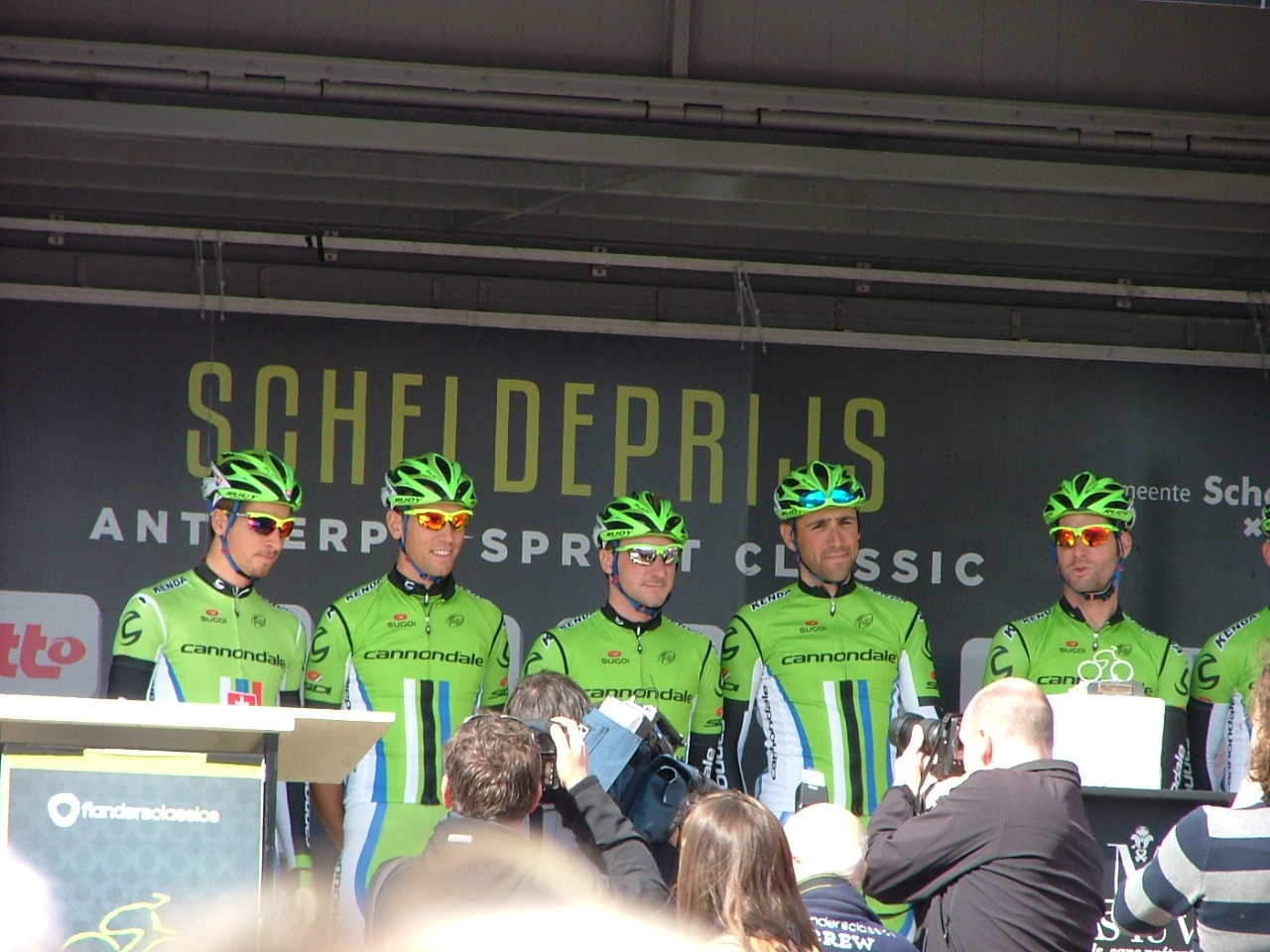
Peter Sagan keeps his hand in between Monuments
Where next?
The race heads out to Schoten, just a few kilometres to the northeast of Antwerp, and takes a 150km loop into the surrounding area before returning to Schoten to complete three 17km circuits through the town. So if you head out to Schoten for the finish, you should get to see the riders pass by at least three times. The most straightforward way to get there seems to be to take bus number 621 from Franklin Rooseveltplaats in the east of the city, not far from the Centraal train station.
After seeing the riders off, we chose instead to spend a few hours in Antwerp. It’s free (and highly recommended) to go up to the panoramic viewing platform on the roof of MAS. Don’t make the mistake of thinking you’ll get a great view of the race from up here, as it starts too close to the building, but there’s a great view of the team buses if that sort of thing floats your boat!

The team buses on their way to Schoten
Perhaps more impressive are the views over the old town and the contrasting one on the other side over the modern day port that stretches for miles along both banks of the Scheldt, a reminder that you are in the second biggest port in Europe.

The old town from the roof of MAS
There’s more to see in Antwerp than can possibly be covered in a single day. There’s history, art, fashion and more, and handily there’s a city bike rental scheme to help you cover more than you could on foot. The red and white bikes are available to hire from docking stations throughout the city and on both sides of the Scheldt. You sign up via the website to subscribe to the service then pay according to how long you hire the bike for, up to four hours. Rates are very reasonable (and the first thirty minutes are free).
A fun place to go for a spin is to take the St Annatunnel under the Scheldt, which is for cyclists and pedestrians only. Coming from MAS you can find the entrance by walking south along the riverbank until a little way past the cathedral.

The easiest (and most fun) way to cross the river
On the other side is the Linkerover (literally Left Bank), which is mostly parkland with great views back across the river to central Antwerp.
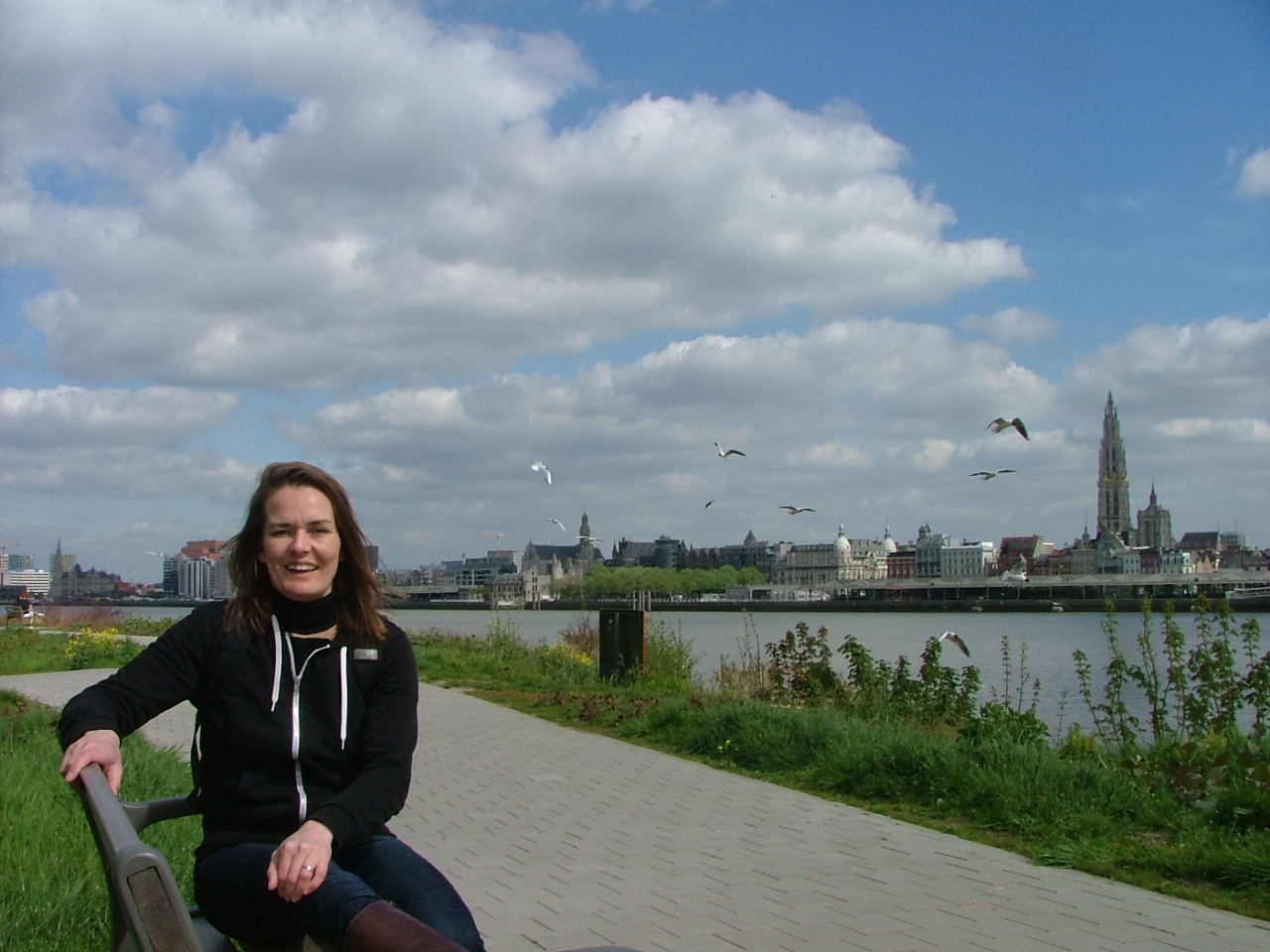
The view from Linkeroever
Antwerp is famous for its nightlife but even looking for a quick watering hole on the way back to the station we were spoilt for choice. We ended up in ‘t Elfde Gebod (the 11th Commandment), superbly located in an ivy-clad building on a cobbled lane in the shadow of the cathedral. Its website doesn’t do it justice but, in keeping with its ecclesiastical neighbour, the inside is adorned with dozens of statues of angels and saints, staring down disapprovingly as we supped on our end-of-day beers.
It was back to Ghent for us, to pick up our bikes and continue on the next leg of our journey to Oudenaarde, the capital of the Tour of Flanders. We didn’t really have enough time to do Antwerp justice in a day, which I suppose means we’ll just have to go back and visit another time.
 Bex on Wheels
Pingback: How to watch Paris – Roubaix | Bex on Wheels