Giro del Lido – how to get your cycling fix in Venice

I was pregnant just over a year ago when we were deciding where to go on holiday and whilst I was still very comfortable cycling at the time, I didn’t fancy planning one of our more gruelling itineraries in case I found that I wasn’t physically up to it or at the very least would be snoring into my dinner by 5pm every night.

So it seemed like the perfect time to finally visit Venice, land of 121 islands and over 400 little bridges with lots of steps that make it a most impractical location for bicycles and baby buggies alike. In fact, cycling is not permitted in the main part of Venice, although you will see the occasional cycle tourist parked up in one of the many picturesque squares, staring at a map and scratching their head as they ponder how to navigate through all those winding narrow streets without taking a turn that will deposit them directly into a canal.
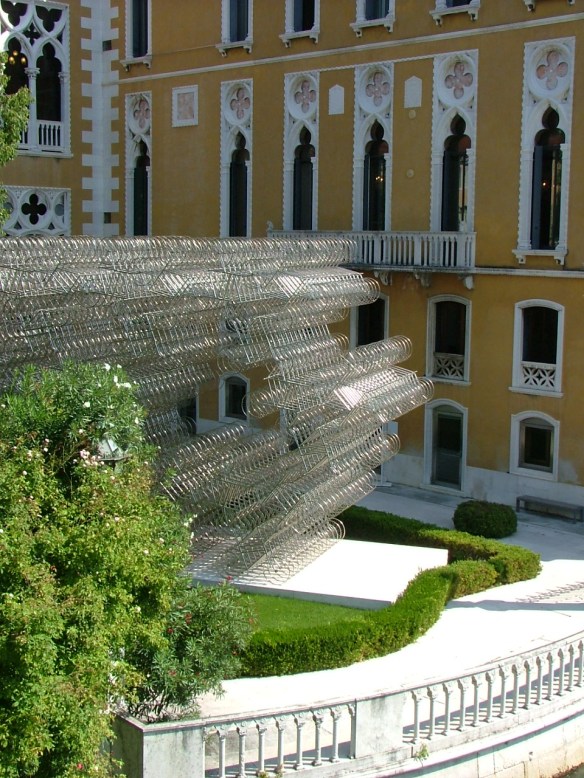
Bicycle sculpture

Bicycle sculpture at the Palazzo Cavalli-Franchetti, Venice


Cycling is permitted, however, on some of the outlying islands in the Venetian lagoon, the most accessible and well known of which is Lido, a slender seven mile long sandbar less than a mile from the main islands of central Venice. Prior to the 1850s very little happened here, although Lord Byron and his pal Shelley used to ride horses among its dunes apparently.  Byron once swam all the way from Lido to Venice and up the Grand Canal (where he regularly used to swim up to ladies’ houses and peer in through the windows, the old goat). Then Europe’s first beach resort was established here, becoming such a hit that we still use the word lido today to refer to outdoor swimming pools. It really hit its stride by the turn of the 20th century, as evidenced by the string of art deco hotels strewn along the eastern beach front.

It’s heyday is behind it, but Lido remains the place where Venetians go to escape the heat and bustle of Venice in the summer and get some beach time. Its flat roads and laid-back vibe also make it a great place for a bike ride if you need a break from all those galleries and gondolas yourself.

Getting there and getting started

Venice is well serviced by a network of vaporetto (water bus) routes, at least half a dozen of which head out to Lido from the Grand Canal and other central locations. A single journey is expensive (EUR 7 at the time of my visit, but then this is the city that  charges a leg-crossing EUR 1.50 to use a public toilet). You can buy tickets valid for 24, 48, 72 hours or a week that are better value if you are staying in Venice for a while.

The vaporetto deposits you at the north end of Lido on the western side of the island, from where there are great views back across the lagoon to Venice, which the following photo doesn’t do justice.

Venice from Lido 3

It’s there if you look hard enough!

From here it’s a short walk to Granviale Santa Maria Elisabetta, a busy shopping street that cuts straight across the island to the beaches on the eastern (sea)side.  There’s a decent supermarket to pick up supplies for a picnic, some restaurants, the obligatory purveyors of plastic seaside tat and, crucially, a number of bicycle hire companies.

We used Lido On Bike, who are located on the left hand side of the Granviale just minutes from the vaporetto stop. They have bikes for all ages and sizes, including child seats, tandems and even a rickshaw.

Bike hire, Lido

Cycling for all family sizes catered for!

Unusually for Venice, bike hire here is a bargain – we paid just EUR 16 euro for four hours of cycling. You don’t have to decide in advance how long you want to hire the bikes for either, you pay when you get back.

Things to do and see

There are a few sites of interest on Lido, including a fourteenth century Jewish cemetery and the church of San Nicolo at the northern end of the island, but considering how much sight-seeing there is to be done back in Venice there’s enough pleasure to be had here from simply cycling about. Unlike the mainland cars are allowed on Lido, but the drivers are considerate around cyclists, surrendering to the island’s relaxed mood.

Head south along Lungomare Guglielmo Marconi on the sea side of the island past a stretch of hotels, each with its own stretch of beach that you are welcome to use – for a fee.  You’ll pass the Palazzo del Cinema, one of the venues for the Venice film festival which contributed to a buzzing atmosphere when we were visiting in September.

Swing back in land and continue south along Via Sandro Gallo, the main artery running the length of the island.  The riding is low key and peaceful, passing through leafy residential areas and the village of Malamocco.

Cycling on Lido 2

Leafy back streets

The road takes you back over to the lagoon side for more easy cycling along a quiet coastal road to the village of Alberoni at the southern tip of the island. If you don’t fancy splashing out to swim at one of the hotel’s beaches then head here for one of Lido’s two public beaches (the other is at the north end and is much busier). It’s not the most glamorous of beaches but it’s spacious and the water is clean. On our Sunday afternoon visit, the endless line of beach huts were busy with noisy extended families enjoying lunch together.

The south public beach

The south public beach


Keen to keep going?

A 15 minute hop by car ferry from Alberoni will take you to the neighbouring island of Pellestrina, another long, thin island to the south of Lido peppered with sleepy fishing villages (vaporetto tickets are accepted on the ferry). Press on further still to the island of Chioggia.

Cycling on Lido 3

Coastal cycling near Alberoni

It may not be the most challenging or memorable cycling you’ll ever do, but it’s a lovely way to spend an quiet afternoon in this most busy of tourist hotspots.
Strade Bianche – a good excuse to visit Tuscany

When is a Classic not a Classic?  Tomorrow’s Strade Bianche possesses many of the characteristics of cycling’s greatest one day races: it’s run in spring in stunning Tuscan countryside, over challenging terrain that makes the race unpredictable, difficult to control and exciting to watch.  Strade Bianche literally means “white roads”, referring to the stretches of white gravel roads scattered throughout the course that evoke Paris-Roubaix in the way the peloton are either choked with dust or coated in filth depending on the weather (check out footage of stage 7 of the 2010 Giro d’Italia, which used some of the same roads, for a graphic illustration of the latter).  The race has been won by Classics superstars such as Philippe Gilbert and Fabian Cancellara, who was done over in last year’s edition by the Cannondale double act of his nemesis Peter Sagan and Moreno Moser, nephew of Italian cycling legend Francesco Moser.

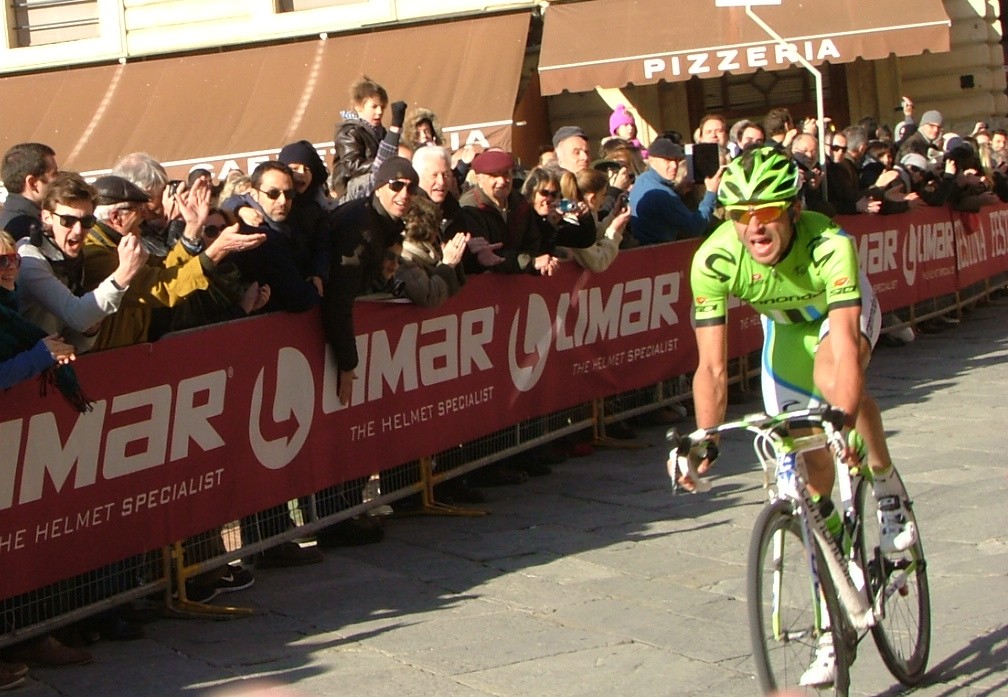
Moreno Moser on his way to victory

Moreno Moser on his way to victory in 2013

Although it has all the hallmarks of a Classic and is sometimes referred to as such, in reality Strade Bianche has only been running since 2007, when Alexandr Kolobnev won the inaugural race (the less said about him the better).  The professional race evolved from the Eroica, a popular event for amateur cyclists who dress in vintage cycling gear (think wool rather than lycra) and ride old school steel-framed bikes (strictly no carbon) for up to 209km along the strade bianche in and around Gaiole in the Chianti region, home of the famous red wine in a basket beloved of fictional cannibalistic serial killers everywhere.

Is it worth the trip?

Are you kidding?  The race is held in Tuscany – the scenery is beautiful, the food and wine is amazing and the finish line is in Siena which is a wonderful place to while away a weekend.  It’s worth making the trip even without the race, but as Tuscany is unbelievably popular with tourists and no doubt horrifically crowded in summer, March is a great time to visit the area and see world-class cyclists at a comparatively low-key and uncrowded event. The main issue for the time-deficient (like me) is how best to spend your time here given that a lifetime would not be long enough to explore everything worth seeing in the region.

Where to watch

There are two schools of thought when it comes to watching road racing live – either you dash from point to point trying to see the race pass as many times as possible, or you hang around at a single (ideally strategic) point along the course with access to a television, so you can actually follow the race but also experience the roadside atmosphere and see the riders whiz by in person.

I’m a proponent of the latter approach, given that I don’t have a car, don’t have local knowledge of the course and enjoy settling in to drink copious amounts of beer when watching races.  The most obvious place to base yourself is usually either the start so you can see the riders sign on or the finish, which for this race is in Siena and was the option we chose last year.

Getting there

Most websites and travel guides will advise flying to Pisa to visit Siena or just about anywhere else in Tuscany.  There are no direct trains to Siena from Pisa, you either need to change at Empoli or take a bus.  Either way be prepared for at least a two-hour journey.

We decided to spend a few days in Siena’s rival Florence, which needs no introduction.  There are direct flights to Florence’s from London City airport, so this was a much better option for us and one I would do again, as I don’t think I could ever have enough of Florence.

I won’t dwell on our stay there as we didn’t do any cycling; all I will say is that Florence was so beautiful I cried when I got home and remembered I lived in Tooting!  One thing worth mentioning though is that we went to a fantastic exhibition of cycling at the Fortezza da Basso, featuring all sorts of vintage steeds and memorabilia including the rainbow jersey of the legendary Alfredo Binda, cycling’s first ever world champion in 1927.

World champion Alfredo Binda's rainbow jersey

World champion Alfredo Binda’s rainbow jersey

Every guidebook you read about Florence will tell you to book tickets to the most famous sights like the Uffizi in advance to avoid the queues.  If you visit in March this isn’t an issue – you can waltz straight into everywhere without waiting at all.

It’s easy to get to Siena from Florence by bus, which takes about an hour.  Buses run from the coach station just over the road from the Stazione di Santa Maria Novella train station.  The bus station in Siena is just on the edge of town – Siena isn’t very big and it’s possible to walk to most places if you’re fit and like hills!  In fact most of the city is pedestrianised so you don’t have a lot of choice.    If you arrive the day before the race and are lucky like we were, you might see some pros out and about in town checking out the route – we saw Taylor Phinney, Greg Van Avermaet and a couple of other BMC guys looking decidedly lost not far from our hotel.

Siena

Palazzo Pubblico, Piazzo del Campo and a marvellous travelling companion

Palazzo Pubblico, Piazzo del Campo and a marvellous travelling companion

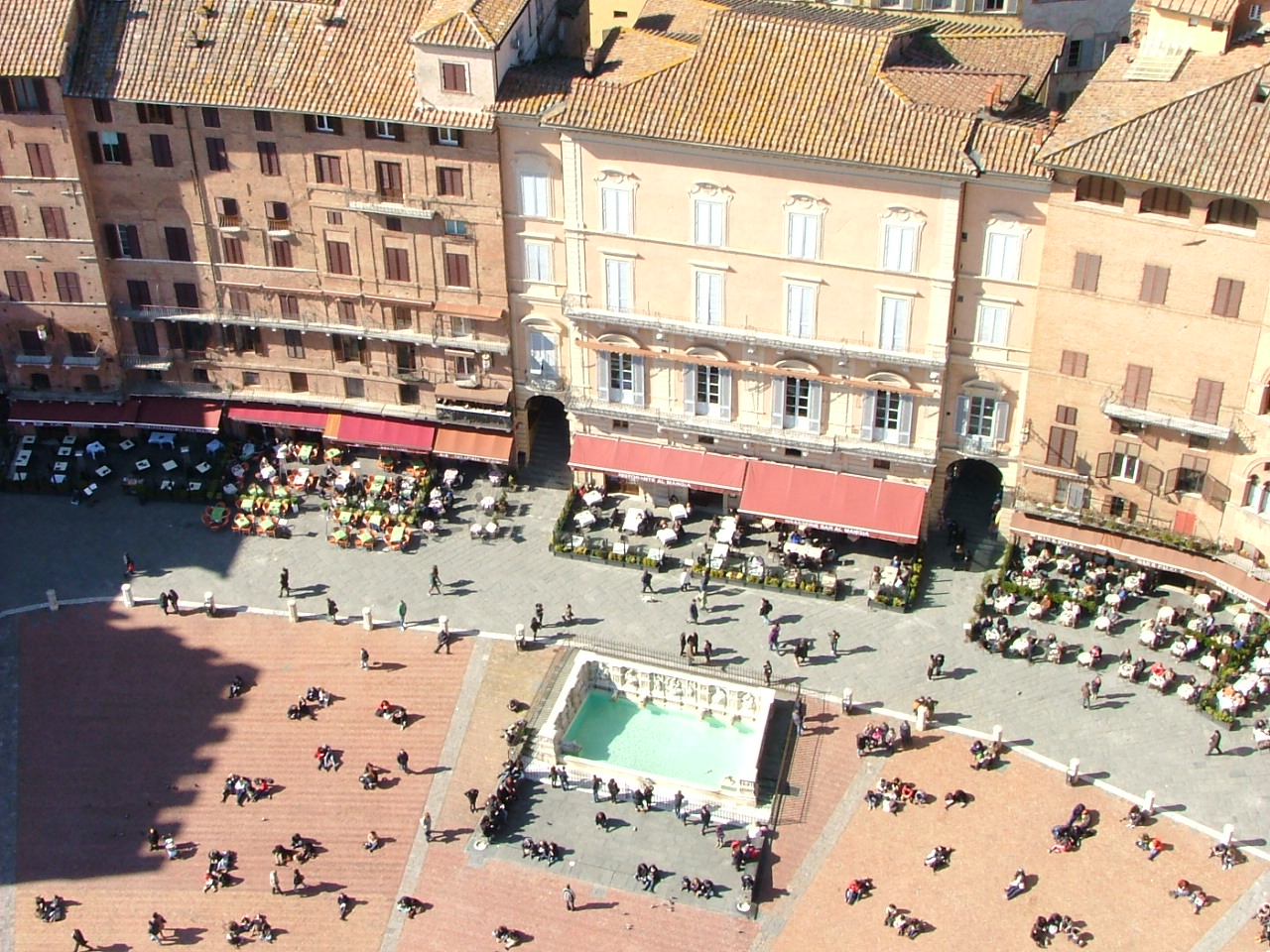
It’s not surprising they’re rivals – Siena is a completely different city to Florence, so it’s definitely worth visiting both to see the contrast.  A maze of narrow, twisting streets tumble between towering medieval buildings to converge on the impressive Piazza del Campo, the vast main square presided over by the enormous clock tower of the Palazzo Pubblico (well worth the 500-step climb to the top of this if you have cyclist’s thighs (naturally) and a head for heights).

View of Il Campo from the tower of the Palazzo Pubblico

View of Il Campo from the tower of the Palazzo Pubblico

The Campo is most famous for the Palio, a bonkers horse race held on two nights in the summer, where rival contrade (town districts) race their nags bareback at full pace three times around the edge of the square. Wandering the streets of Siena (which never gets old), the locations of the different contrade can be identified by their mascots such as caterpillars, owls, snails and so on that decorate the relevant streets.

Those things you see all over the place

Contrade mascot

While strolling about make sure to walk up Via Di Fontebranda – it’s a steep flag-stoned climb that the pros must scale at the end of the race as they enter the city.  It would break the knees of you or me (well, me anyway) but is not considered significant enough to even mention in the road book or the commentary.

Back to the race…

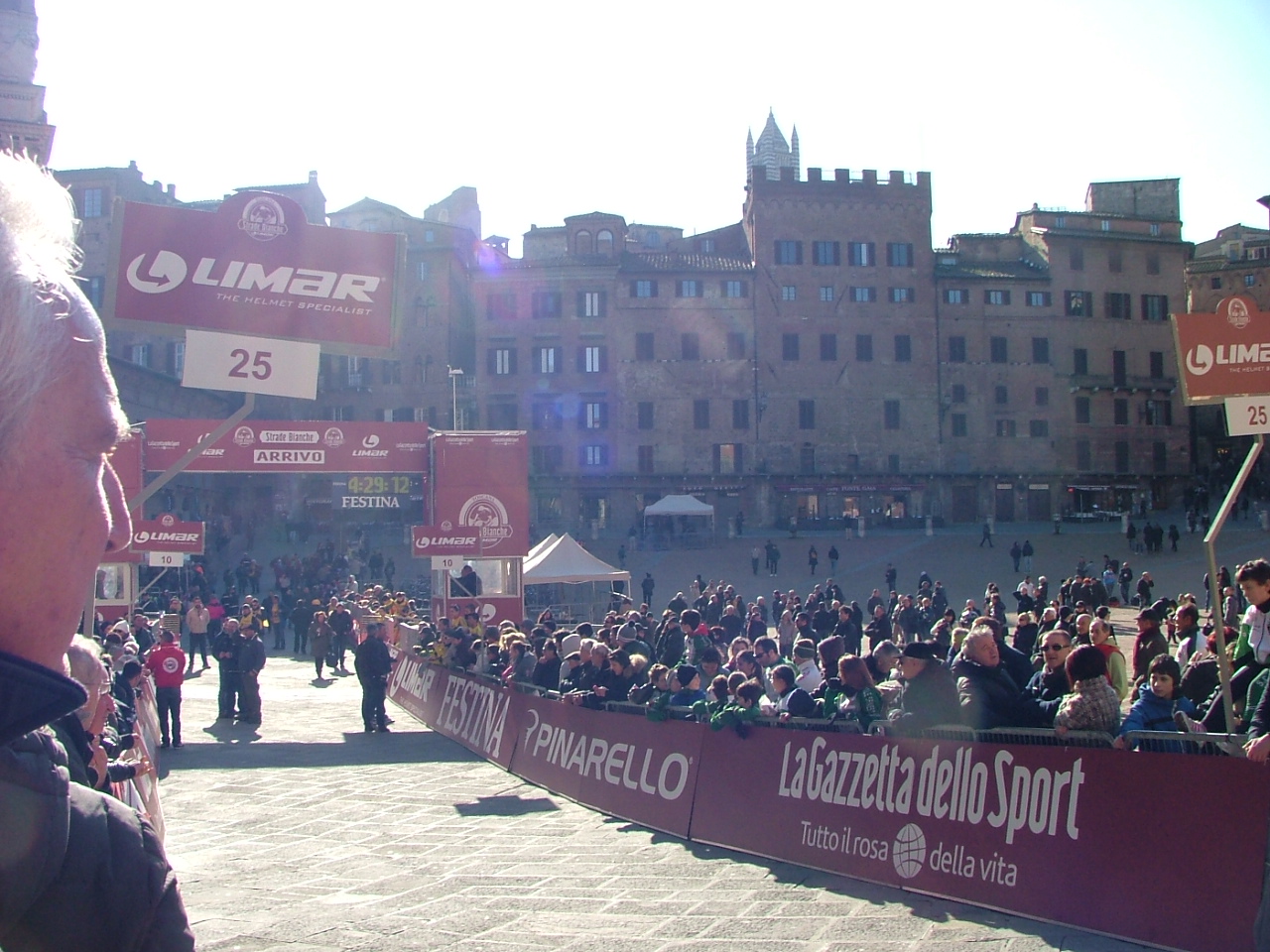
Like the Palio, the finishing line of Strade Bianche is located in Il Campo.  As I mentioned earlier, the Strade Bianche is much more low key than other spring races like the Tour of Flanders, so you don’t have to get there particularly early if you want a place along the finishing straight.

The not-so-hectic finish line in Siena

The not-so-hectic finish line in Siena

The Campo is lined with restaurants and bars, many of which have televisions, but don’t make the mistake we did and assume they will be showing the reasonably prestigious bike race about to finish on their doorstep.  We tried several but no joy – I guess in a region where cycle racing is so much a part of the fabric that a local TV channel shows clips of the achievements of Gastone Nencini on continuous loop, bike races finish here all the time.  I would suggest scoping out a few places the day before elsewhere in the city and ask if they plan to show the race.

Anyway, we were fortunate that the organisers RCS had hired Anthony McCrossan to provide commentary in English that was relayed by loud-speaker over the square, where we sat in the early spring sun and enjoyed a couple of beers before bagging a spot at the finishing straight barrier next to an elderly Italian gentleman who almost had a coronary with joy when Moser crossed the line first.

The podium ceremony was suitably chaotic, with the press and spectators congregating in the finishing straight whilst most of the field were still coming in.  In fact we accidentally found ourselves kettled with the paparazzi when someone finally attempted to control the situation, which made for a good photo opportunity.

The podium l-r: Peter Sagan (2nd), Moreno Moser (1st), Rinaldo Nocentini (3rd)

The podium l-r: Peter Sagan (2nd), Moreno Moser (1st), Rinaldo Nocentini (3rd)

Are there other ways to see the race?

With a 197km route through glorious countryside there are plenty of other places you could choose to try and catch the race whilst enjoying what Tuscany has to offer. It’s worth downloading a copy of the road book to check out the full route, as it changes a little each year.  In fact it’s worth downloading a copy anyway so that you can enjoy the Google-translated introduction, which last year featured the following description of the race:

“It can be considered as the earthliest, the most terrestrial, territorial and ground-to-ground race…The “Strade Bianche” is a maze of country, rustic, peasant roads which never met asphalt, far from traffic, silent or grumbling, dusty or muddy, all at the same vegetal and mineral, bestial and animal, two-wheeled or four-legged.”

Couldn’t have put it better myself!

Last year the race passed through the outskirts of Siena early on so we attempted to catch the race twice although we botched our timing and only saw the briefest flash of fluo-yellow lycra from about half a mile away. This year the race starts in San Gimignano, famous for its medieval towers built by competing families and somewhere I have never been, so if I was going again I’d be tempted to head there for the sign-in.

Another way to experience the route, which is definitely on my to-do list, is to have a go at the Eroica.  The event is held in October and there are four routes varying from 38km to 209km in length.  Alternatively the route is signposted all year round, so there’s nothing to stop you tackling it any time at any pace you fancy.  Seems like a good excuse to go back to Tuscany some time, not that I need one.

I’ll let the road book have the last line about this terrific race: “In a word: timeless cycle racing”.  Amen.

Next time

It’s only four weeks until the Tour of Flanders, my favourite race and one I’ve been to a few times, so I’ll try to get some top tips out a little earlier rather than the day before.