Every time somebody wants to make an easy point about the increasing popularity of cycling in the UK, they talk about the amazing crowds that amassed along the route of the Olympic road race in 2012 or when London hosted Le Grande Depart in 2007. When you think about it though, it would have been weirder if there hadn’t been a terrific turnout for these events, given that both the Olympics and the Tour de France are renowned major global sporting events that are free to watch from the side of the road. Ask your typical Brit if they’ve heard of the Tour of Flanders however, and they’ll blink and ask if you meant to say the Tour de France. Yet on the first Sunday in April each year a corner of Belgium comes alive as over 800 000 people line the streets, country lanes and cobbled farm-tracks of Western Flanders to cheer on the protagonists of a bike race like no other. All cycling fans owe it to themselves to go to Belgium to soak up the incredible atmosphere of the Tour of Flanders at least once in their lives. If you’re anything like me you’ll end up going back time and again.
What’s it all about?
Pro cycling is a big deal in Belgium, especially Flanders. Only France and Italy have more nationals riding in the ProTour peloton than Belgium, a nation that has produced some of the greatest racers the sport has ever seen, including five-times Tour de France winner and cycling’s nonpareil Eddy Merckx. Merckx is also one of just three men to win all five Monuments, along with fellow Belgians Roger de Vlaeminck and Rik Van Looy.

Banner seen in Bruges at the time of the 2013 Tour of Flanders
The Tour of Flanders, or the Ronde van Vlaanderen to use the local name, is one of said Monuments. In a country with more bike races than you can shake a stick at, the Ronde is considered the most prestigious; any son of Flanders would take a win in the Ronde over the Tour de France any time and 68 of the editions run annually since 1913 (except during World War 1) have been won by Belgians. The Ronde is raced in a single day over more than 250km but what makes it Monumental and extremely tough to win are the hellingen; short but very steep climbs, often cobbled to add to the fun, that sap the riders’ strength and make the race difficult to control. The winner is usually a hard man who can deal not just with the repetitive climbing and cobbles but also the constant battle for position to be at the front of the group on the narrow and technical approaches to the climbs. Combined with a nervous peloton on one of the biggest race days of the year, this unique course generates frequent crashes, and riders who get stuck behind one are likely to see any chance of victory disappearing up the road without them.
The nature of the route means the race is usually a great one to watch but what truly makes it unique is the passion of the local fans for cycling in general and their favourite race in particular, which has to be seen to be believed. The day of the Ronde has the atmosphere of a national festival – it feels like half the country is having a day out watching the race (and they probably are), and everybody has an opinion on who is going to win (although most locals will probably say “Tom Boonen”, a national superstar and three-time winner who can barely set foot out of the door without being papped. His visage even makes it onto pillows of questionable quality in gift shops that otherwise mostly sell beer).
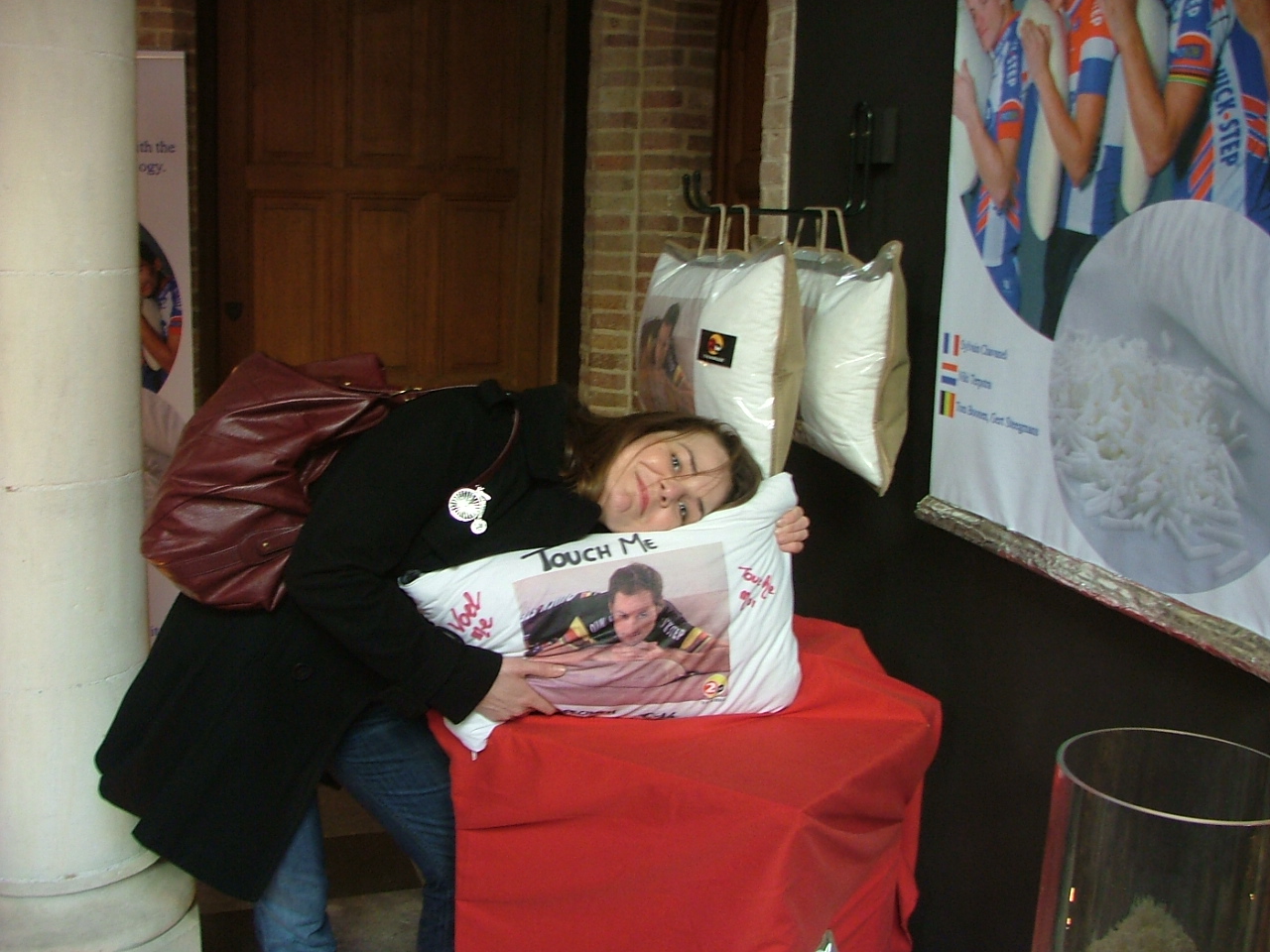
“Official” Tom Boonen merchandise
If you just happened to be visiting somewhere like Bruges for some chocolate and beer tourism on Ronde weekend, it would be hard not to notice that something was up. Daily newspaper Het Nieuwsblad publishes a 24 page pullout on the day before the race, featuring rider interviews, punditry, predictions and all sorts of other minutiae – worth picking up even if you can’t read Dutch as it contains details of the race route and timetable, and it usually comes with a freebie like a souvenir bidon or even a can of beer specially packaged for the occasion. The race result usually makes front page news in the Monday edition too, with more full-colour pull-outs making it a good souvenir.
2011 even saw the production of a TV mini series called – what else? – De Ronde, based around a series of fictional events that culminated on the 2010 race day. I even found myself watching this at one point – after enough pints of Kwaremont (yes, there’s a beer named after one of the race’s most iconic climbs), you start to convince yourself you can understand Dutch but in truth I have no idea what the program was about.
The sign-in
The route of the Ronde has changed many times over the years but since 1998 it has started in Bruges, or Brugge in Dutch. This medieval gem needs little introduction, but should anyone need one I’m intending to do a separate post about it at a later date, as it’s a great place to spend a few days and base yourself for some cycling in the region. Thousands of people fill the Markt before the start of the race, which is a good place to experience the excitement generated by the local fans and see an all-star list of professional cyclists in the flesh and up close.
On race day, a stage is erected for the occasion in front of the Belfort in the Markt, where the riders sign in for the race. They pedal up a ramp on the right hand side, possibly get flagged down for an interview if they are famous or just plain Belgian, then pedal off through the middle of the crowd – barriers are set up to demark the way, so it’s obvious where to stand for a good view of this.
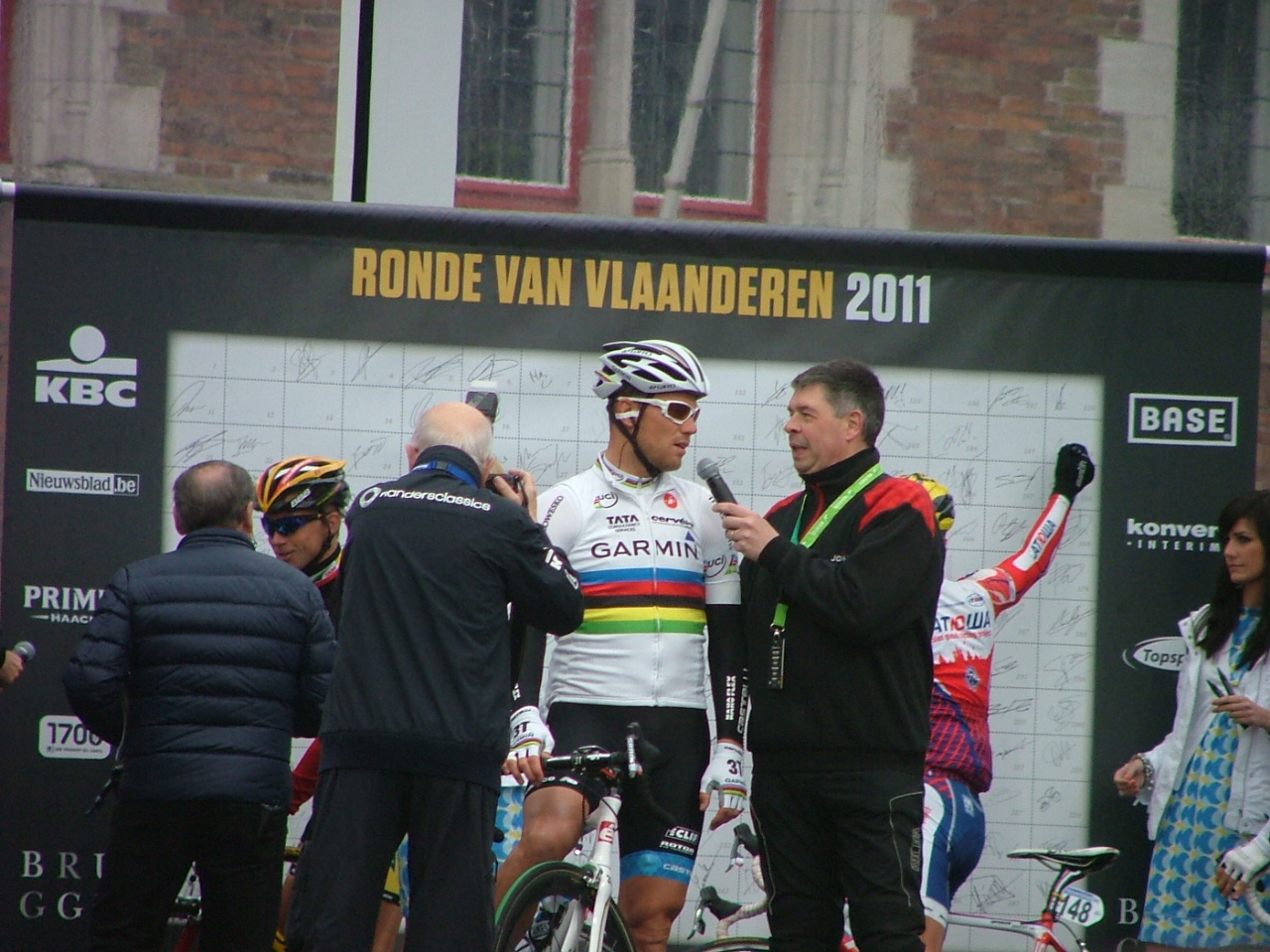
World champion Thor Hushovd signs in in 2011
In between rider interviews a live band plays music verging on oompah that presumably appeals to some Belgian demographic or other. Ronde legends like three-time winners Eric Leman and Johan Museeuw and world champion turned museum curator Freddy Maertens are wheeled out to give their predictions (Boonen, Boonen, Boonen) to fill gaps where necessary. Foreign riders are usually interviewed in English so foreign fans like me can still mostly follow what’s going on. The volume of riders signing in increases as the start time approaches; it was very cold last year so many riders left it as late as possible. There is a noticeable ripple of excitement from the largely local crowd when Tom Boonen makes his entrance.
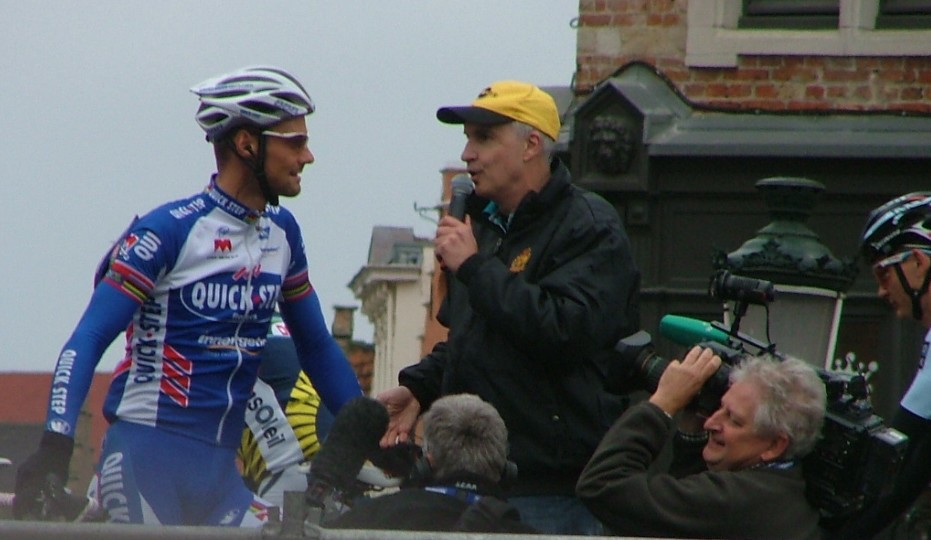
Tom Boonen gets flagged down for an interview before even making it to the stage
I like Tom Boonen, but I reserve my own personal ripples of excitement for this guy:
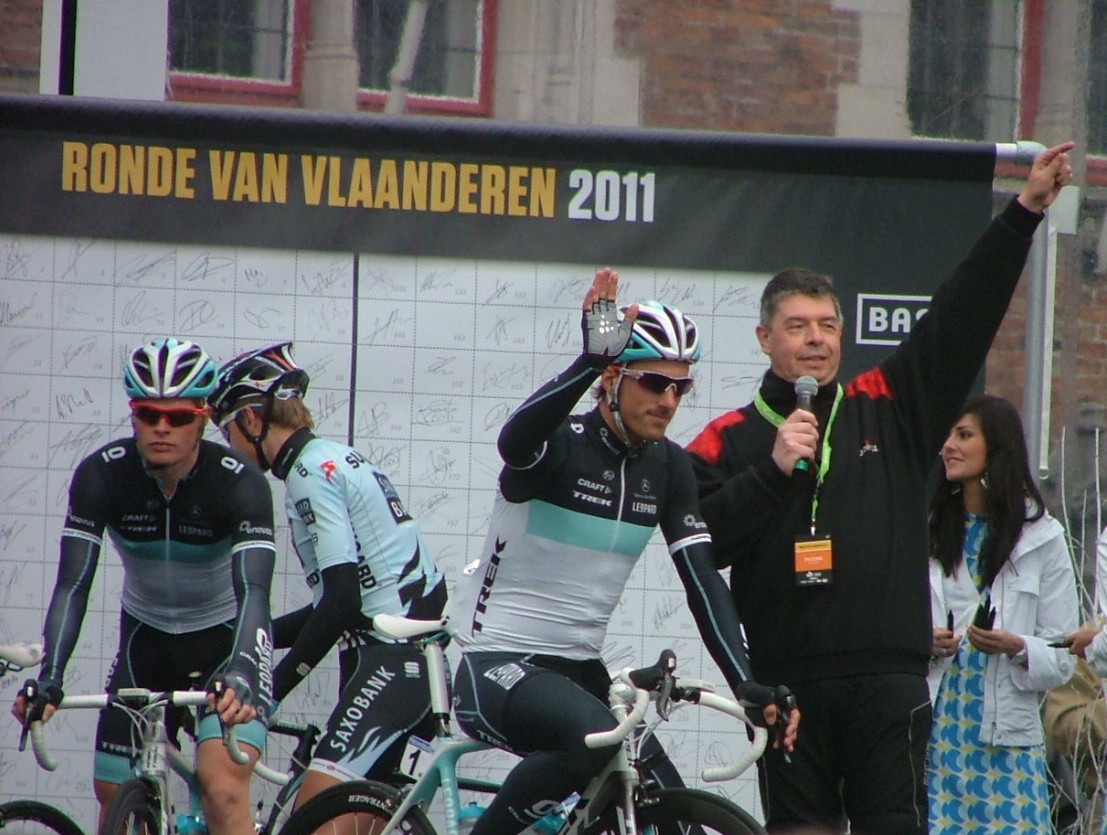
“No, I’m Spartacus”
Anyway, the race starts at 10am, so get down there for 9am at the latest, earlier if you want to get a good view. If you fancy a liquid breakfast you’ll be right at home, as some fans will have started on the Jupiler already. There’s usually people handing out yellow and black Flandrian lion flags and other souvenirs. As 10 o’clock approaches, three or more helicopters start to circle the by-now packed market square, a claxon sounds and the race is off!
Where next?
The route of the Ronde is a convoluted one, winding back and forth through the Flemish Ardennes in order to string together a succession of climbs that sit in near proximity to each other to create over 250km of difficult racing. The twisting nature of the route has traditionally lent itself well to viewing the race multiple times for those with local knowledge of how best to scamper from one helling to the next.
There are an increasing number of tour companies offering some variation on the theme of a Tour of Flanders weekend, usually combining the opportunity to ride the sportive on Saturday (more on that in a later post) with watching the professional race on Sunday. Some of these packages offer places in the various VIP tents at strategic points along the route, others keep it old school and drive you from place to place so you can see the race pass several times. I’ve never used any of these companies so can’t really comment – driving point to point with someone who knows what they’re doing sounds like it could be a lot of fun, but is being increasingly discouraged by the race organisers due to traffic jams as the Ronde gets more popular each year. Also let’s be honest – seeing the race live is the whole point of going there, but if you actually want to follow it you need to see it on TV. For me the best way to experience any race is to soak up the atmosphere from a good spot by the course with access to a screen, so you can follow what is actually going on, punctuated with bursts of live action as the race zips by. The aforementioned VIP tents enable this experience but frankly I’m not sure there’s any point paying for one; there are plenty of free public zones at strategic parts of the course with big screens, beer tents and friet vans – what more do you need?
Once the race has left Bruges you will notice much of the crowd moving with great purpose in the direction of the train station – follow them. To see the race again you need to get to Oudenaarde, which is the location of the finish line and the natural heart of the race since it was controversially rerouted away from Geraardsbergen in 2012. Take a train to Kortrijk and change there for Oudenaarde.

Oudenaarde loves the Ronde
Once there, one option is to follow the crowd into the centre of town, admiring en route the efforts of local businesses to dress their shop windows in celebration of the big day. Oudenaarde has an impressive town hall and market square, which is used as a place to park the team coaches on race day and therefore a place to stalk exhausted riders after the race. It’s also the location of the Ronde Van Vlaanderen museum, where I’m hoping to spend some quality time this year.
The race is scheduled to pass through Oudenaarde between 12.30pm and 1pm, so you could hang about to see this plus a few impromptu warm up acts such as a pedal-powered bar, a mime artist called Bom Toonen and the occasional recreational cyclist who is just passing through and slightly embarrassed by the drunken cheer he’s receiving. After this you could head to the nearby public zone by the finish line, or alternatively wander into the nearest bar, order a Leffe and watch the race on TV with a bar full of drunk Belgians. Just remember to cheer for Tom Boonen.

Oudenaarde market square
Alternatively, if you want to see the pointy end of the race, you can take a free shuttle bus from Oudenaarde station up to the public village on the Oude Kwaremont. This cobbled climb often proves significant to the outcome of the race, which passes through this point three times.

Geraint Thomas on the Oude Kwaremont
This is a great place to see the race – there are pubs, food and beer vans, a big screen, plenty of portaloos and room to stand by the road if you’re prepared to shuffle along a bit. We had no problem switching between standing by the roadside and going back to the big screen with each passing of the peloton. It was here that my friend Lisa and I were memorably told we were “commendable” for travelling all the way from London to see the race.

View up the Oude Kwaremont
Shuttle buses also run to the Oude Kwaremont from Ronse and Kluisbergen. The bus from Ronse also goes to the public zone at the Kruisberg. There are further public zones at the Paterberg and Koppenberg, which aren’t serviced by shuttle bus, however this year the organisers have also devised bicycle routes between major points on the race, which I’m currently weighing up the pros and cons of – more details of buses and bike routes can be found on the Flanders Classics website.
Getting there
My Ronde addiction is enabled by the accessibility of Belgium from the UK. Eurostar runs from London St Pancras International to Brussels Midi, and your ticket will cover you for a transfer from here to anywhere in Belgium, so you can get straight to Bruges or anywhere else you want to visit first.
Want to take your bike? This is straightforward on Eurostar, you can either collapse it all into a bike bag and take it on as luggage, or what we normally do is register them as luggage in advance for £30 each way so we can simply ride off at the other end. You can also turn up and register your bike on the day but there’s no guarantee your bike will travel on the same train as you – more details about bikes on Eurostar here.
You can take bikes on trains in Belgium but you need to buy a ticket for them, which costs either EUR 5 per journey or EUR 8 for unlimited journeys in a day. Depending on what sort of train turns up, the bikes either go in the guard’s cabin behind the driver or in specially marked carriages. It’s always slightly nerve wracking wondering if you’ve got the right end of the platform but generally there’s always a guard and people are very helpful.
What else?
There’s so much more I want to tell you about this race, how to ride the route, riding in Belgium generally and so on but I’ve probably bored you enough for the time being. Tomorrow we’re setting off to see our fourth Ronde, travelling by ferry this time for a change, and extending our trip to see Scheldeprijs and Paris-Roubaix too, so there’ll be lots more from me in coming weeks!




 Bex on Wheels