Getting close to the Tour de France in Brittany

The Tour de France is in full swing, starting this year in the cycling-mad region of Brittany. Brittany is a big place, almost twice the size of Wales, yet as luck would have it the Tour route passes through the exact area where I cycled with my family three years ago. It was our first holiday with our son who was just five months old at the time and we were anxious to find a cycling holiday that could accommodate him but still be satisfying for us. A Google search for family-friendly cycling holidays led us to Breton Bikes, based in Gouarec in the heart of the region.

The owners, Geoff and Kate, have been running cycling holidays here for nearly 30 years and promised a great experience for families having toured with their own children over the years. They were true to their word; they fitted out a trailer with a car seat so that our baby didn’t bounce around in the back and the gite where we stayed had a high chair, cot, stair gates and other necessary accoutrements. We were provided with suggested routes that were suitable for those with such extra baggage, over flattish terrain and manageable distances. For those with older children or no children at all there are tagalongs, kids’ bikes, tandems and multiple camping options, with both point-to-point and out-and-back cycling routes offered.
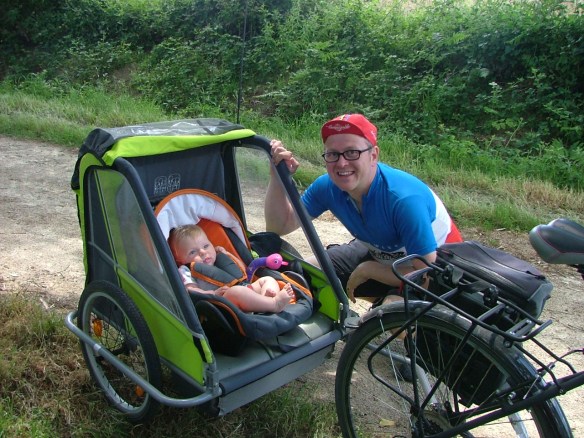
Family cycling in Brittany

All families catered for!

Gouarec is also a great base for a cycling holiday. Although it’s a sleepy little village on the Nantes-Brest canal, it has everything you need, including a superb bakery, a handful of restaurants including a pizzeria and a village shop which though small has a broader range of stock than your average supermarket, with a decent wine selection and fresh meat counter. Even better, on the day of writing, stage 6 of this year’s Tour de France rode straight through the middle of it!

Riding the Voie Verte to Mur de Bretagne

Many of Breton Bike’s suggested routes out from Gouarec start with a 5km ride along the foxglove-trimmed tow path to the ruins of the 12th century abbey of Bon Repos. After racing through Gouarec, stage 6 passed by here with 35km to go on its way to Mur de Bretagne, where the stage finished after two ascents. The abbey hosts a sound and light show in August.
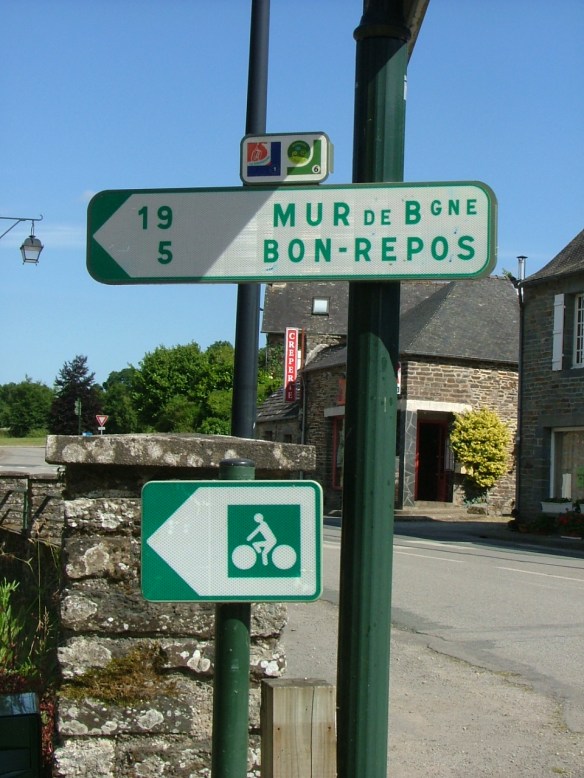
Mur de Bretagne

Stage 6 passed through Gouarec, Bon Repos and Mur de Bretagne

We stopped off here on a Sunday, when a farmers’ market was in full flow and families fished in and picnicked by a nearby stream. We enjoyed a delicious plat du jour of spit-roasted ham at the bar there before taking an accidental detour under a viaduct while on the look-out for some Neolithic ruins that were allegedly somewhere nearby.

Viaduct near Bon Repos

Taking a wrong turn is not always a bad thing

To get to Mur de Bretagne we actually needed to go over rather than under this viaduct, taking a tree-lined voie verte (a traffic-free greenway) through gradually rising farmlands to the Lac de Guerledan, which had been drained for maintenance at the time of our visit but is apparently rather beautiful under normal circumstances. You can read more about the lake and Bon Repos on the Breton Bikes website.
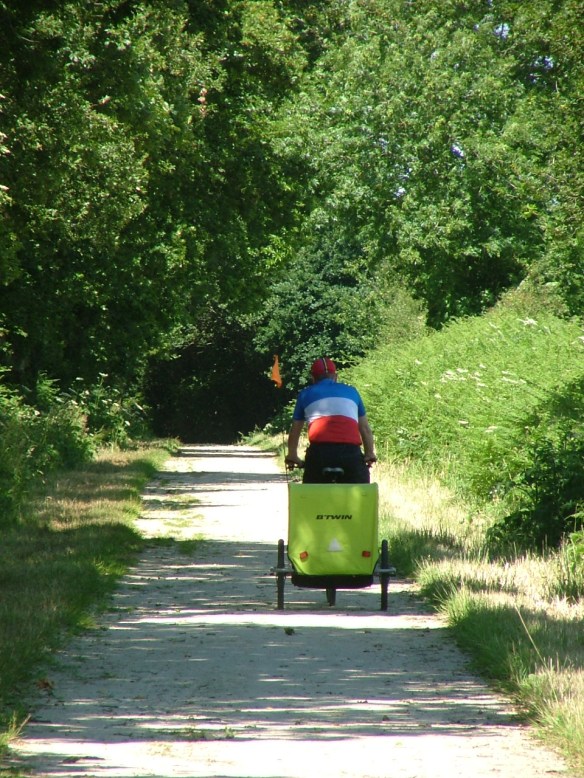
Scenic riding to Mur de Bretagne

Scenic riding to Mur de Bretagne

Cycling in Brittany

The moderately alluring voie verte

The voie verte runs along a former railway line and eventually rolls into the town of Mur de Bretagne at its old railway station, which is mercifully at the top of the very steep hill that presumably give the town its “wall” moniker. When we were there the town was gearing up to host the finale of a Tour de France stage, which was won by Alexis Vuillermoz (Dan Martin won the 2018 edition). Shop windows were painted with cartoons of cyclists and the mayoral residence was resplendent in polka dots!
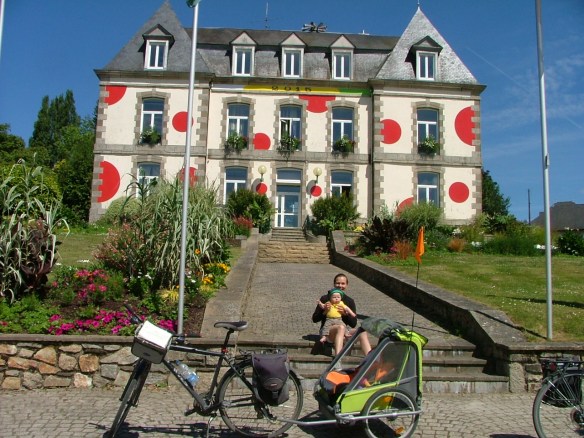
Mur de Bretagne

The town hall stakes its claim to be king of the mountains

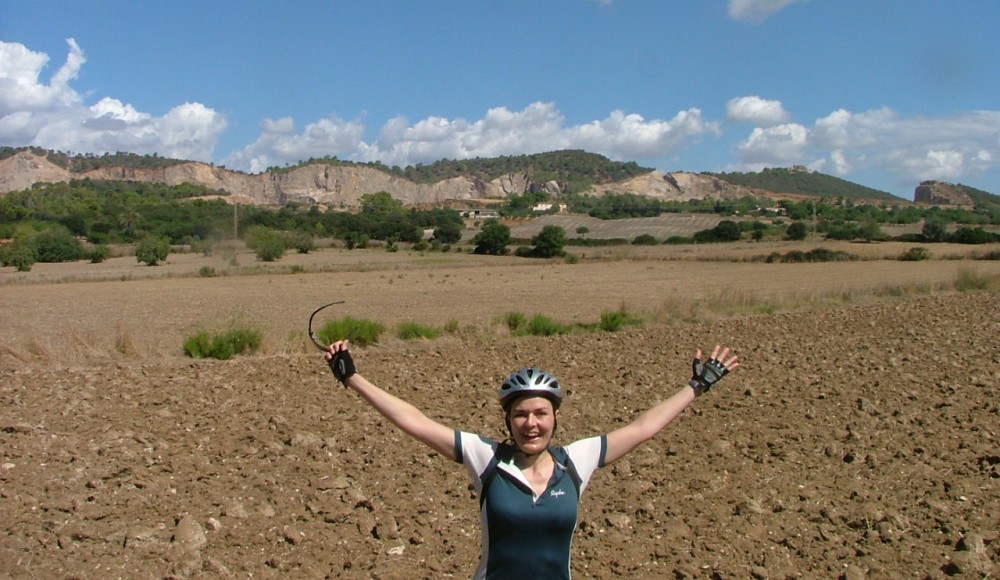
On a non-Tour day Mur de Bretagne is a typically sleepy village, with fantastic views across Brittany from its lofty vantage point. We enjoyed a fast descent into St Aignan and took a meandering route back home via canal paths and pretty villages whose cottages sported brightly painted shutters and well-tended gardens. The problem with getting lost in this area is the ubiquitous rolling hills, so we ended up climbing more than we intended to, but I enjoyed being able to keep pace with my husband for once as he was hampered by the trailer.

A good thing about getting lost was that we got to enjoy the rather lovely Forêt de Quénécan.
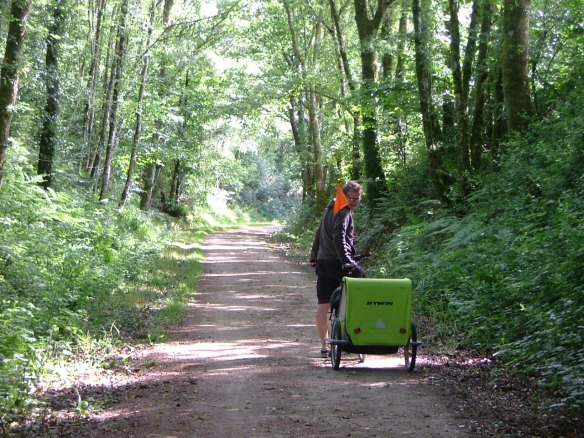
Forêt de Quénécan

Getting lost in the Forêt de Quénécan

Eventually we ended up on main road back to Gourarec, although even this was quiet and the drivers courteous to cyclists (the only aggressive drivers we experienced all week were British). This route took us through the hamlet of Ste Brigette, worth mentioning because it is the location of a really quite fantastic creperie that Geoff recommended – and I do too!

Also in the area
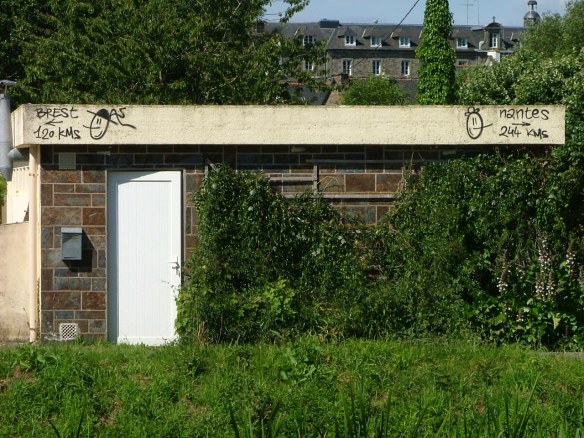
Brest-Nantes canal

The campsite at Gouarec sits a third of the way along the canal from Brest to Nantes

Gouraec sits on the Nantes-Brest canal, offering bountiful opportunities for peaceful, family friendly cycling. The stretch near Rostrenen is particularly pretty, although frustratingly no one seems to have taken the initiative to turn one of the many cute little locksmith cottages nestled in the rushes along its route into a refreshment stand. After a long ride along here one day I started severely bonking and we had to take an inevitably uphill detour to Gomnel to buy an ice cream from the only shop in town that was open. Nowhere ever seems to be open in these little French towns, except the mystifyingly numerous barber shops.

Nantes - Brest canal

Idyllic riding along the Nantes – Brest canal

Near Ste Brigitte we discovered we were on a section of Le Grand Circuit Jean Robic, a cycle route devised for tourists in honour of 1947 Tour de France winner Jean Robic. Although he was born in the Ardennes, Robic is always considered to be a son of Brittany, where he grew up.

Following in the wheels of Jean Robic

Following in the wheels of Jean Robic

The whole area is criss-crossed with car-free cycle paths strewn with cornflowers and hedgerows populated with colourful song birds, weaving up and down through farmers’ fields and woodlands draped in mistletoe. It’s perfect for families of all ages and I’m sure we will be back.
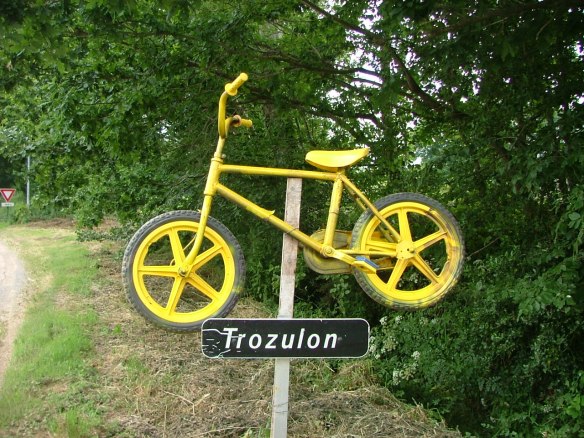
Cycling in Brittany

You’re never far away from a bicycle in Brittany

Getting there

As usual we travelled by Eurostar to Paris, from there it’s a two and a half hour train ride to St Brieuc. If travelling by ferry St Malo or Roscoff are your best bets. Breton Bikes can help you with travel arrangements and transfers if you book with them.

How to watch Paris – Roubaix

No sooner had Philippe Gilbert crossed the line in glory at last weekend’s Tour of Flanders than the cycling world’s attention turned towards this Sunday, when the Queen of Classics herself, Paris – Roubaix, will bring down the curtain on this year’s cobbled races and four-time champion Tom Boonen’s career. Will he pull off a record fifth win and a fairy-tale ending? Will Peter Sagan stay upright this time and spoil the party? Will Greg Van Avermaet live up to his newfound status as Flanders’ favourite and bag that first monument win?

On the train home from Belgium this year following my fifth trip to the Ronde, I remembered that I had yet to blog about my only trip so far to see the Hell of the North. Three years ago my husband John and I spent just over a week cycling from London to Bruges, Ghent, Oudenaarde and finally Lille, taking in the Tour of Flanders, Scheldeprijs and Paris – Roubaix along the way. If you just want to take in Paris – Roubaix on its own, this is easy to do as Roubaix is essentially a suburb of Lille, easily accessible from the UK via Eurostar.

The road to Roubaix

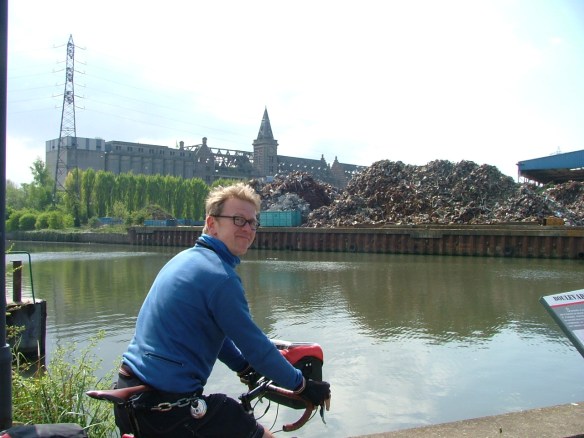
The last stage of our journey was to cycle about 80 km from Oudenaarde to Lille, where we were going to base ourselves for Paris – Roubaix two days later. To do the same you simply head south out of town from the Tour of Flanders museum and town square and turn right onto the cycle path running alongside the Scheldt river. If you keep your wits about you and keep your eye out for signs to the relevant towns, this path will carry you all the way to Lille via Berchem, Avelgem, Spiere and Roubaix. At Spierre you turn west along the Canal de l’Espierres which later turns into the Canal de Roubaix.

Although not quite as lovely as the stretch of the river between Ghent and Oudenaarde, the majority of this route is still pretty scenic, featuring plenty of blossom and ducklings at this time of year.

The road to Roubaix

The Roubaix Canal

As you approach Roubaix and Lille, things take a more industrial turn, but the high quality tracks and helpful signposts you have come to expect from cycling in Belgium happily continue into France; it’s very difficult to lose your way.

The road to Roubaix

Keeping it real on the outskirts of Lille

The Roubaix canal, unsurprisingly, leads you to Roubaix itself. Although this is ultimately the place you have come to visit, you do not want to linger here. Some of the districts we passed through reminded me of The Wire and I was grateful we didn’t have to stop to fix punctures or similar. Keep Roubaix for race day and instead keep on the signed cycle route that wiggles west along traffic-free paths through less apocalyptic suburbs in the north of the city before turning south to end in the city centre.

How not to watch Paris Roubaix

Unlike the Tour of Flanders, whose route looks like someone drew Mr Messy on the area surrounding Oudenaarde and allows you to see the race several times, Paris- Roubaix is a 250 km slog north in a mostly straight line from Compeigne. Even with a car it would be difficult to see the race in more than one place due to road blocks and parking issues.

Apparently there are big screens at Arenberg, site of the notorious “trench” of bastard cobbles that extend for nearly two and a half kilometres which were helpfully suggested for inclusion by former Arenberg mine worker and professional cyclist Jean Stablinski in the 1960s. I’m not sure you’d want to spend the day there though and it’s 100km from the finish line. An alternative is to do what we did and watch the finale in the iconic velodrome of Roubaix, which is certainly easier to get to if you’re travelling by bike or public transport as we were.

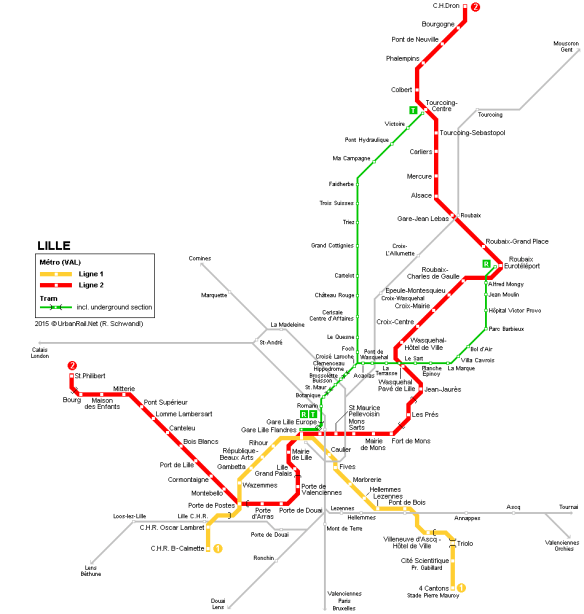
As I’ve already hinted at, Roubaix is not the sort of location where you’d want to stay the night but Lille, just 15 km southwest, is fine and where you need to be to catch the Eurostar home from anyway. Lille’s public transport system, which links to Roubaix, is easy to navigate, centring around two metro lines and two tram lines. All lines and trams run from Gare Lille Flanders and Gare Lille Europe in the centre of town.

Lille metro system

Lille metro system

Like clowns we boarded Metro line 2 on the day of the race and got off at Roubaix – Grand Place, assuming the location of the velodrome would become magically obvious once we got there. How big could Roubaix be?

As we were belatedly scrutinising a map at the station and getting nowhere, three lovely men in high vis vests appeared from nowhere, asked us what we were up to and sucked their teeth in Gallic fashion when we told them we were looking for the velodrome. They told us we should stay on until the next stop (Gare Jean Lebas) and take bus number citi 5 from there to the velodrome.  All three men then kindly but inexplicably accompanied us to the next station and deposited us at the right bus stop. I’ve no idea what their job was or why it required three of them to do it. No wonder the French civil service is collapsing under the weight of its own expenditure.

Anyway, this bus stop epitomised the Hell of the North better than a silly old bike race ever could. I don’t think I’ve ever spent a longer half hour waiting for a bus, feeling incredibly uneasy in what was clearly a very rough neighbourhood where Bad Things could happen at any time. I do not recommend you take this route to the velodrome unless you enjoy sizing up every passing pedestrian as a potential mugger and spending time with your partner in terrified silence.

The bus took us on a scenic route through a selection of similarly dicey neighbourhoods before grinding to a halt in a slightly better area where signs to the velodrome had started to appear. Ironically the cause of our delay was road closures due to the race itself, so we got out and walked the rest of the way.

The route we should have taken to the velodrome was the reverse of the route we ended up taking home, which I do recommend. Take tram R east to Parc Barbieux or Hopital Victor Provo and follow the signs from there for Velodrome STAB (named in honour of Jean Stablinski, not because you might get stabbed on the way. I think). If you’re riding there’s a cycle path following this tram route, but be aware that you might find it a struggle to park your bike safely at the velodrome.

However you get there, get there early enough to enjoy a stroll along the last stretch of cobbles leading to the velodrome, where the names of former winners are inscribed on individual stones.

The velodrome

The race finishes in the old veldodrome (there’s a newish indoor one next door) somewhere between 4 and 5.30 pm, but obviously you’ll want to get there at least two hours before to bag a place on the edge of the track and to watch the race unfold on the big screen.

Roubaix velodrome

Roubaix velodrome

After the carnival atmosphere of Flanders, the set-up here felt like a bit of a damp squib to be honest. There was one beer concession and not a frituur in sight. Still, entry is free and there was plenty going on with the finale of the juniors taking place ahead of the pros and the usual eccentric in vintage dress having a go. As the day and the race went on the spectator areas gradually filled up and the anticipation started to build.

Tom Boonen's maiden Roubaix victory

Tom Boonen’s maiden Roubaix victory

Paris – Roubaix nearly always throws up an unpredictable, exciting race and the 2014 edition was no exception. With just a few kilometres to go and in trademark fashion, Niki Terpstra clipped off the front of an elite group of riders to solo to victory before our eyes in the Roubaix velodrome.

Niki Terpstra Paris - Roubaix 2014

Niki Terpstra checks to see if his lead is holding up

John Degenkolb outsprinted Fabian Cancellara for second place from a group that included Peter Sagan, Tom Boonen, Bradley Wiggins and Sep Vanmarcke.

Paris - Roubaix 2014

Cycling’s finest wind it up for the sprint for second place

Staying in Lille

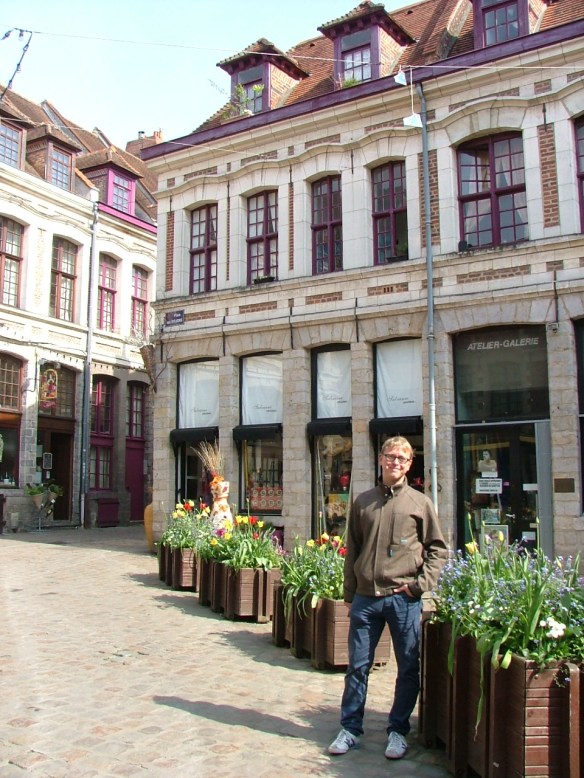
As well as being very convenient for watching Paris – Roubaix, Lille has its charms and is worth a day or two of your time. It’s crammed with grand civic buildings that hark back to its glory days as a major centre for textiles in the 16th and 17th centuries and the old town is a charming network of narrow cobbled streets packed with interesting shops. Look out for cheesemongers selling Pave de Roubaix, a hard, strong cheese with a shape resembling that of one of the infamous cobble stones.

Vieux Lille

Vieux Lille

The food is mostly Flemish in nature, which means hearty and/or mussel-based, often involving beer. There are lots of good restaurants along the Rue de Gand including the atmospheric Cave aux Fioles and the Trois Brasseurs near the central train stations is  a must to sample their delicious blonde, brune, ambre and blanche beers brewed on the premises.

The 3 brasseurs, Lille

4 great beers at The 3 Brasseurs,

Getting there

Eurostar runs from London St Pancras International to Lille Europe and you can take your bike with you as luggage if you take it in a bike bag. Alternatively you can book your bike on as luggage in advance for £30 each way which means you can simply ride off when you get to the other end.  You can also turn up and register your bike on the day but there’s no guarantee your bike will travel on the same train as you – more details about bikes on Eurostar here.

Compared to Brussels or Paris, taking your bike on Eurostar is more frustrating in Lille because you have to squish your bike through their x-ray machine and lift it on and off rather than simply handing it over to someone who presumably does all that behind closed doors.

Is it worth it?

Definitely. My favourite race remains the Tour of Flanders and the incredible atmosphere on race day and the opportunities for brilliant cycling in the area mean that I will continue to go there year after year. I don’t feel the same draw to go back to see Paris – Roubaix repeatedly, but as it remains one of the greatest and most entertaining races on the calendar, I know I’ll be back at some point.